•  

US: Wildfire Erupts in Pittman Center, East Tennessee, Prompts Evacuation 2

A wildfire erupted in the town of Pittman Center, eastern Tennessee on Tuesday, March 4, prompting evacuations of nearby residents. This video was filmed from a car driving on US 321 highway.

  •  
CHINA-BEIJING-CENTRAL AXIS-LISTED UNESCO WORLD HERITAGE (CN)

CHINA-BEIJING-CENTRAL AXIS-LISTED UNESCO WORLD HERITAGE (CN)

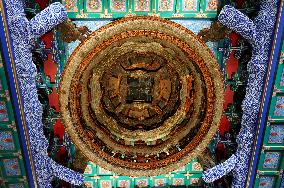
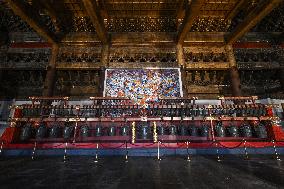
(240727) -- BEIJING, July 27, 2024 Photo by Xinhua/ABACAPRESS.COM) -- This photo taken on July 17, 2024 shows a caisson ceiling of the Longfu Temple displayed in Taisui hall of the Altar of the God of Agriculture in Beijing, capital of China. The United Nations Educational, Scientific and Cultural Organization (UNESCO) on Saturday announced the inclusion of the Beijing Central Axis: A Building Ensemble Exhibiting the Ideal Order of the Chinese Capital, into its world heritage list. So far, China has a total of 59 World Heritage Sites. Beijing Central Axis, initially established in the 13th century and formed in the 16th century, runs through the old city of Beijing from north to south. It has become the longest urban axis in the world today, spanning 7.8 kilometers. The heritage area of the Beijing Central Axis covers 589 hectares, with a buffer zone of 4,542 hectares. Its location, layout, urban form, and design reflect the ancient Chinese tradition of urban planning, serving as an important emblem that high

  •  
CHINA-BEIJING-CENTRAL AXIS-LISTED UNESCO WORLD HERITAGE (CN)

CHINA-BEIJING-CENTRAL AXIS-LISTED UNESCO WORLD HERITAGE (CN)

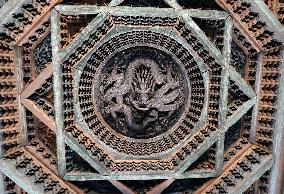
(240727) -- BEIJING, July 27, 2024 Photo by Xinhua/ABACAPRESS.COM) -- This photo taken on July 17, 2024 shows a caisson ceiling of the Longfu Temple displayed in the worship hall of the Altar of the God of Agriculture in Beijing, capital of China. The United Nations Educational, Scientific and Cultural Organization (UNESCO) on Saturday announced the inclusion of the Beijing Central Axis: A Building Ensemble Exhibiting the Ideal Order of the Chinese Capital, into its world heritage list. So far, China has a total of 59 World Heritage Sites. Beijing Central Axis, initially established in the 13th century and formed in the 16th century, runs through the old city of Beijing from north to south. It has become the longest urban axis in the world today, spanning 7.8 kilometers. The heritage area of the Beijing Central Axis covers 589 hectares, with a buffer zone of 4,542 hectares. Its location, layout, urban form, and design reflect the ancient Chinese tradition of urban planning, serving as an important emblem that

  •  
CHINA-BEIJING-CENTRAL AXIS-LISTED UNESCO WORLD HERITAGE (CN)

CHINA-BEIJING-CENTRAL AXIS-LISTED UNESCO WORLD HERITAGE (CN)

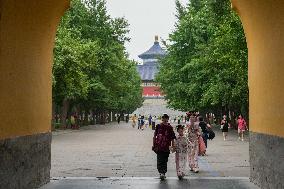
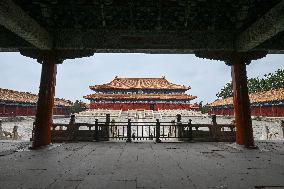
(240727) -- BEIJING, July 27, 2024 Photo by Xinhua/ABACAPRESS.COM) -- Tourists visit the Temple of Heaven in Beijing, capital of China, July 19, 2024. The United Nations Educational, Scientific and Cultural Organization (UNESCO) on Saturday announced the inclusion of the Beijing Central Axis: A Building Ensemble Exhibiting the Ideal Order of the Chinese Capital, into its world heritage list. So far, China has a total of 59 World Heritage Sites. Beijing Central Axis, initially established in the 13th century and formed in the 16th century, runs through the old city of Beijing from north to south. It has become the longest urban axis in the world today, spanning 7.8 kilometers. The heritage area of the Beijing Central Axis covers 589 hectares, with a buffer zone of 4,542 hectares. Its location, layout, urban form, and design reflect the ancient Chinese tradition of urban planning, serving as an important emblem that highlights the distinctive characteristics of Chinese civilization. Photo by Xinhua/ABACAPRESS.C

  •  
CHINA-BEIJING-CENTRAL AXIS-LISTED UNESCO WORLD HERITAGE (CN)

CHINA-BEIJING-CENTRAL AXIS-LISTED UNESCO WORLD HERITAGE (CN)

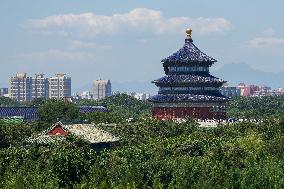
(240727) -- BEIJING, July 27, 2024 Photo by Xinhua/ABACAPRESS.COM) -- Tourists visit the Temple of Heaven in Beijing, capital of China, June 25, 2024. The United Nations Educational, Scientific and Cultural Organization (UNESCO) on Saturday announced the inclusion of the Beijing Central Axis: A Building Ensemble Exhibiting the Ideal Order of the Chinese Capital, into its world heritage list. So far, China has a total of 59 World Heritage Sites. Beijing Central Axis, initially established in the 13th century and formed in the 16th century, runs through the old city of Beijing from north to south. It has become the longest urban axis in the world today, spanning 7.8 kilometers. The heritage area of the Beijing Central Axis covers 589 hectares, with a buffer zone of 4,542 hectares. Its location, layout, urban form, and design reflect the ancient Chinese tradition of urban planning, serving as an important emblem that highlights the distinctive characteristics of Chinese civilization. Photo by Xinhua/ABACAPRESS.C

  •  
CHINA-BEIJING-CENTRAL AXIS-LISTED UNESCO WORLD HERITAGE (CN)

CHINA-BEIJING-CENTRAL AXIS-LISTED UNESCO WORLD HERITAGE (CN)

(240727) -- BEIJING, July 27, 2024 Photo by Xinhua/ABACAPRESS.COM) -- This photo taken on July 16, 2024 shows an interior view of the front hall of the Imperial Ancestral Temple in Beijing, capital of China. The United Nations Educational, Scientific and Cultural Organization (UNESCO) on Saturday announced the inclusion of the Beijing Central Axis: A Building Ensemble Exhibiting the Ideal Order of the Chinese Capital, into its world heritage list. So far, China has a total of 59 World Heritage Sites. Beijing Central Axis, initially established in the 13th century and formed in the 16th century, runs through the old city of Beijing from north to south. It has become the longest urban axis in the world today, spanning 7.8 kilometers. The heritage area of the Beijing Central Axis covers 589 hectares, with a buffer zone of 4,542 hectares. Its location, layout, urban form, and design reflect the ancient Chinese tradition of urban planning, serving as an important emblem that highlights the distinctive characterist

  •  
CHINA-BEIJING-CENTRAL AXIS-LISTED UNESCO WORLD HERITAGE (CN)

CHINA-BEIJING-CENTRAL AXIS-LISTED UNESCO WORLD HERITAGE (CN)

(240727) -- BEIJING, July 27, 2024 Photo by Xinhua/ABACAPRESS.COM) -- This photo taken on July 16, 2024 shows a view of the Imperial Ancestral Temple in Beijing, capital of China. The United Nations Educational, Scientific and Cultural Organization (UNESCO) on Saturday announced the inclusion of the Beijing Central Axis: A Building Ensemble Exhibiting the Ideal Order of the Chinese Capital, into its world heritage list. So far, China has a total of 59 World Heritage Sites. Beijing Central Axis, initially established in the 13th century and formed in the 16th century, runs through the old city of Beijing from north to south. It has become the longest urban axis in the world today, spanning 7.8 kilometers. The heritage area of the Beijing Central Axis covers 589 hectares, with a buffer zone of 4,542 hectares. Its location, layout, urban form, and design reflect the ancient Chinese tradition of urban planning, serving as an important emblem that highlights the distinctive characteristics of Chinese civilization.

  •  
(MASTER OF CRAFTS)CHINA-BEIJING-CARVED LACQUER-INHERITOR (CN)

(MASTER OF CRAFTS)CHINA-BEIJING-CARVED LACQUER-INHERITOR (CN)

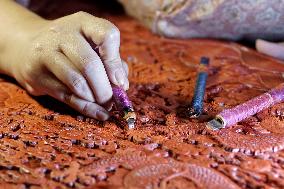
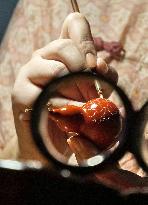
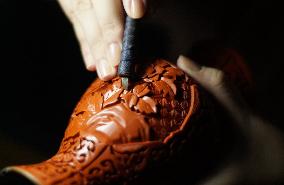
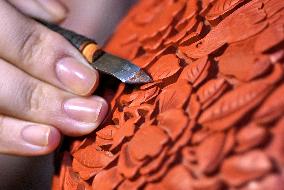
(230927) -- BEIJING, Sept. 27, 2023 (Xinhua) -- Hai Yan watches gourd-shaped wares before carving at her studio in the Cheng'en Temple in Beijing, capital of China, Sept. 8, 2023. "Finely detailed by exquisite engraving, the figure of the beauty is captured vividly. Thousand layers of lacquer, glistening bright, even make Chang'e envy of its radiance." This poem describes the exquisiteness of carved lacquer. The craft is to apply colorful lacquers onto a ware, ranging from twenty or thirty to over a hundred layers, and then engrave patterns on the lacquers. It is known for its intensive labor, high cost, complex procedures, and excellent skill and is also called the "art of time". There are various lacquer carving techniques nowadays, including flat carving, relief carving, hollow carving, and three-dimensional carving. A large or medium-sized artwork costs at least a year or more to complete. Hai Yan, an artisan of lacquer carving born in the 1980s, graduated from the College of Art and Design at Beijing Uni

  •  
(MASTER OF CRAFTS)CHINA-BEIJING-CARVED LACQUER-INHERITOR (CN)

(MASTER OF CRAFTS)CHINA-BEIJING-CARVED LACQUER-INHERITOR (CN)

(230927) -- BEIJING, Sept. 27, 2023 (Xinhua) -- Hai Yan makes a large piece of carved lacquer artwork at her studio in the Cheng'en Temple in Beijing, capital of China, Sept. 8, 2023. "Finely detailed by exquisite engraving, the figure of the beauty is captured vividly. Thousand layers of lacquer, glistening bright, even make Chang'e envy of its radiance." This poem describes the exquisiteness of carved lacquer. The craft is to apply colorful lacquers onto a ware, ranging from twenty or thirty to over a hundred layers, and then engrave patterns on the lacquers. It is known for its intensive labor, high cost, complex procedures, and excellent skill and is also called the "art of time". There are various lacquer carving techniques nowadays, including flat carving, relief carving, hollow carving, and three-dimensional carving. A large or medium-sized artwork costs at least a year or more to complete. Hai Yan, an artisan of lacquer carving born in the 1980s, graduated from the College of Art and Design at Beijing

  •  
(MASTER OF CRAFTS)CHINA-BEIJING-CARVED LACQUER-INHERITOR (CN)

(MASTER OF CRAFTS)CHINA-BEIJING-CARVED LACQUER-INHERITOR (CN)

(230927) -- BEIJING, Sept. 27, 2023 (Xinhua) -- Hai Yan makes a carved lacquer artwork at her studio in the Cheng'en Temple in Beijing, capital of China, Sept. 8, 2023. "Finely detailed by exquisite engraving, the figure of the beauty is captured vividly. Thousand layers of lacquer, glistening bright, even make Chang'e envy of its radiance." This poem describes the exquisiteness of carved lacquer. The craft is to apply colorful lacquers onto a ware, ranging from twenty or thirty to over a hundred layers, and then engrave patterns on the lacquers. It is known for its intensive labor, high cost, complex procedures, and excellent skill and is also called the "art of time". There are various lacquer carving techniques nowadays, including flat carving, relief carving, hollow carving, and three-dimensional carving. A large or medium-sized artwork costs at least a year or more to complete. Hai Yan, an artisan of lacquer carving born in the 1980s, graduated from the College of Art and Design at Beijing University of

  •  
(MASTER OF CRAFTS)CHINA-BEIJING-CARVED LACQUER-INHERITOR (CN)

(MASTER OF CRAFTS)CHINA-BEIJING-CARVED LACQUER-INHERITOR (CN)

(230927) -- BEIJING, Sept. 27, 2023 (Xinhua) -- Hai Yan makes a carved lacquer artwork at her studio in the Cheng'en Temple in Beijing, capital of China, Sept. 8, 2023. "Finely detailed by exquisite engraving, the figure of the beauty is captured vividly. Thousand layers of lacquer, glistening bright, even make Chang'e envy of its radiance." This poem describes the exquisiteness of carved lacquer. The craft is to apply colorful lacquers onto a ware, ranging from twenty or thirty to over a hundred layers, and then engrave patterns on the lacquers. It is known for its intensive labor, high cost, complex procedures, and excellent skill and is also called the "art of time". There are various lacquer carving techniques nowadays, including flat carving, relief carving, hollow carving, and three-dimensional carving. A large or medium-sized artwork costs at least a year or more to complete. Hai Yan, an artisan of lacquer carving born in the 1980s, graduated from the College of Art and Design at Beijing University of

  •  
(MASTER OF CRAFTS)CHINA-BEIJING-CARVED LACQUER-INHERITOR (CN)

(MASTER OF CRAFTS)CHINA-BEIJING-CARVED LACQUER-INHERITOR (CN)

(230927) -- BEIJING, Sept. 27, 2023 (Xinhua) -- Hai Yan makes a large piece of carved lacquer artwork at her studio in the Cheng'en Temple in Beijing, capital of China, Sept. 8, 2023. "Finely detailed by exquisite engraving, the figure of the beauty is captured vividly. Thousand layers of lacquer, glistening bright, even make Chang'e envy of its radiance." This poem describes the exquisiteness of carved lacquer. The craft is to apply colorful lacquers onto a ware, ranging from twenty or thirty to over a hundred layers, and then engrave patterns on the lacquers. It is known for its intensive labor, high cost, complex procedures, and excellent skill and is also called the "art of time". There are various lacquer carving techniques nowadays, including flat carving, relief carving, hollow carving, and three-dimensional carving. A large or medium-sized artwork costs at least a year or more to complete. Hai Yan, an artisan of lacquer carving born in the 1980s, graduated from the College of Art and Design at Beijing

  •  
(MASTER OF CRAFTS)CHINA-BEIJING-CARVED LACQUER-INHERITOR (CN)

(MASTER OF CRAFTS)CHINA-BEIJING-CARVED LACQUER-INHERITOR (CN)

(230927) -- BEIJING, Sept. 27, 2023 (Xinhua) -- Hai Yan observes and draws patterns on ancient architectures at the Cheng'en Temple in Beijing, capital of China, Sept. 19, 2023. "Finely detailed by exquisite engraving, the figure of the beauty is captured vividly. Thousand layers of lacquer, glistening bright, even make Chang'e envy of its radiance." This poem describes the exquisiteness of carved lacquer. The craft is to apply colorful lacquers onto a ware, ranging from twenty or thirty to over a hundred layers, and then engrave patterns on the lacquers. It is known for its intensive labor, high cost, complex procedures, and excellent skill and is also called the "art of time". There are various lacquer carving techniques nowadays, including flat carving, relief carving, hollow carving, and three-dimensional carving. A large or medium-sized artwork costs at least a year or more to complete. Hai Yan, an artisan of lacquer carving born in the 1980s, graduated from the College of Art and Design at Beijing Unive

  •  
(MASTER OF CRAFTS)CHINA-BEIJING-CARVED LACQUER-INHERITOR (CN)

(MASTER OF CRAFTS)CHINA-BEIJING-CARVED LACQUER-INHERITOR (CN)

(230927) -- BEIJING, Sept. 27, 2023 (Xinhua) -- Hai Yan makes a carved lacquer artwork at her studio in the Cheng'en Temple in Beijing, capital of China, Sept. 8, 2023. "Finely detailed by exquisite engraving, the figure of the beauty is captured vividly. Thousand layers of lacquer, glistening bright, even make Chang'e envy of its radiance." This poem describes the exquisiteness of carved lacquer. The craft is to apply colorful lacquers onto a ware, ranging from twenty or thirty to over a hundred layers, and then engrave patterns on the lacquers. It is known for its intensive labor, high cost, complex procedures, and excellent skill and is also called the "art of time". There are various lacquer carving techniques nowadays, including flat carving, relief carving, hollow carving, and three-dimensional carving. A large or medium-sized artwork costs at least a year or more to complete. Hai Yan, an artisan of lacquer carving born in the 1980s, graduated from the College of Art and Design at Beijing University of

  •  
(MASTER OF CRAFTS)CHINA-BEIJING-CARVED LACQUER-INHERITOR (CN)

(MASTER OF CRAFTS)CHINA-BEIJING-CARVED LACQUER-INHERITOR (CN)

(230927) -- BEIJING, Sept. 27, 2023 (Xinhua) -- Hai Yan makes a large piece of carved lacquer artwork at her studio in the Cheng'en Temple in Beijing, capital of China, Sept. 8, 2023. "Finely detailed by exquisite engraving, the figure of the beauty is captured vividly. Thousand layers of lacquer, glistening bright, even make Chang'e envy of its radiance." This poem describes the exquisiteness of carved lacquer. The craft is to apply colorful lacquers onto a ware, ranging from twenty or thirty to over a hundred layers, and then engrave patterns on the lacquers. It is known for its intensive labor, high cost, complex procedures, and excellent skill and is also called the "art of time". There are various lacquer carving techniques nowadays, including flat carving, relief carving, hollow carving, and three-dimensional carving. A large or medium-sized artwork costs at least a year or more to complete. Hai Yan, an artisan of lacquer carving born in the 1980s, graduated from the College of Art and Design at Beijing

  •  
(MASTER OF CRAFTS)CHINA-BEIJING-CARVED LACQUER-INHERITOR (CN)

(MASTER OF CRAFTS)CHINA-BEIJING-CARVED LACQUER-INHERITOR (CN)

(230927) -- BEIJING, Sept. 27, 2023 (Xinhua) -- Hai Yan makes a carved lacquer artwork at her studio in the Cheng'en Temple in Beijing, capital of China, Sept. 8, 2023. "Finely detailed by exquisite engraving, the figure of the beauty is captured vividly. Thousand layers of lacquer, glistening bright, even make Chang'e envy of its radiance." This poem describes the exquisiteness of carved lacquer. The craft is to apply colorful lacquers onto a ware, ranging from twenty or thirty to over a hundred layers, and then engrave patterns on the lacquers. It is known for its intensive labor, high cost, complex procedures, and excellent skill and is also called the "art of time". There are various lacquer carving techniques nowadays, including flat carving, relief carving, hollow carving, and three-dimensional carving. A large or medium-sized artwork costs at least a year or more to complete. Hai Yan, an artisan of lacquer carving born in the 1980s, graduated from the College of Art and Design at Beijing University of

  •  
Nara Sansai-style tiles unearthed in Toshodaiji

Nara Sansai-style tiles unearthed in Toshodaiji

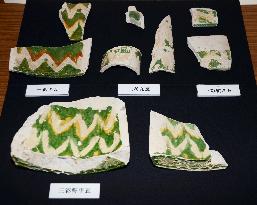
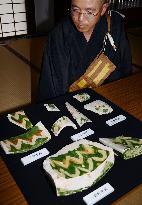
NARA, Japan - Fragments of Nara Sansai (tricolor) -style tiles with a unique wave design unearthed at Toshodaiji temple in Nara, western Japan, are displayed in Nara on Oct. 9, 2014.

  •  
Nara Sansai-style tiles unearthed in Toshodaiji

Nara Sansai-style tiles unearthed in Toshodaiji

NARA, Japan - Fragments of Nara Sansai (tricolor) -style tiles with a unique wave design unearthed at Toshodaiji temple in Nara, western Japan, are displayed in Nara on Oct. 9, 2014.

  •  
CHINA-HENAN-LUOYANG-LONGMEN GROTTOES-RESTORATION (CN)

CHINA-HENAN-LUOYANG-LONGMEN GROTTOES-RESTORATION (CN)

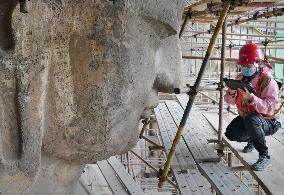
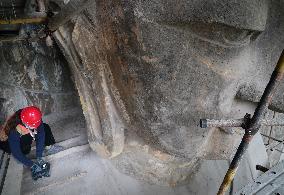
(220416) -- LUOYANG, April 16, 2022 (Xinhua) -- A staff member surveys a Buddha statue at the Fengxian Temple of Longmen Grottoes during a restoration project in Luoyang, central China's Henan Province, April 14, 2022. A restoration project is now underway at the Fengxian Temple, the largest cave of Longmen Grottoes. Water seepage and perilous rock bases are the two factors that threaten the existence of cultural relics in the grottoes. New technologies have been adopted in the restoration, such as ground penetrating radar detection and protective nets design. This has been the first large-scale restoration project of the temple since 1970s. The restoration started in December 2021 and has so far completed about 70 percent. The whole project is expected to finish in June this year. (Xinhua/Li An)

  •  
CHINA-HENAN-LUOYANG-LONGMEN GROTTOES-RESTORATION (CN)

CHINA-HENAN-LUOYANG-LONGMEN GROTTOES-RESTORATION (CN)

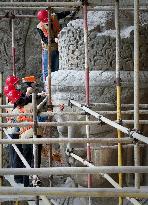
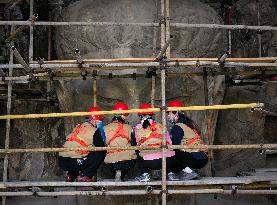
(220416) -- LUOYANG, April 16, 2022 (Xinhua) -- Staff members examine a Buddha statue at the Fengxian Temple of Longmen Grottoes during a restoration project in Luoyang, central China's Henan Province, April 14, 2022. A restoration project is now underway at the Fengxian Temple, the largest cave of Longmen Grottoes. Water seepage and perilous rock bases are the two factors that threaten the existence of cultural relics in the grottoes. New technologies have been adopted in the restoration, such as ground penetrating radar detection and protective nets design. This has been the first large-scale restoration project of the temple since 1970s. The restoration started in December 2021 and has so far completed about 70 percent. The whole project is expected to finish in June this year. (Xinhua/Li An)

  •  
CHINA-HENAN-LUOYANG-LONGMEN GROTTOES-RESTORATION (CN)

CHINA-HENAN-LUOYANG-LONGMEN GROTTOES-RESTORATION (CN)

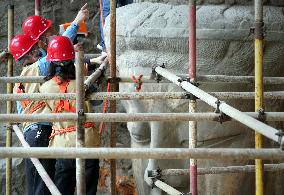
(220416) -- LUOYANG, April 16, 2022 (Xinhua) -- Staff members examine a Buddha statue at the Fengxian Temple of Longmen Grottoes during a restoration project in Luoyang, central China's Henan Province, April 14, 2022. A restoration project is now underway at the Fengxian Temple, the largest cave of Longmen Grottoes. Water seepage and perilous rock bases are the two factors that threaten the existence of cultural relics in the grottoes. New technologies have been adopted in the restoration, such as ground penetrating radar detection and protective nets design. This has been the first large-scale restoration project of the temple since 1970s. The restoration started in December 2021 and has so far completed about 70 percent. The whole project is expected to finish in June this year. (Xinhua/Li An)

  •  
CHINA-HENAN-LUOYANG-LONGMEN GROTTOES-RESTORATION (CN)

CHINA-HENAN-LUOYANG-LONGMEN GROTTOES-RESTORATION (CN)

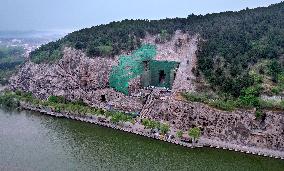
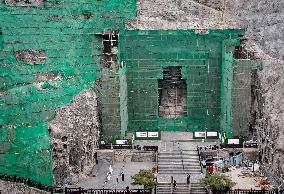
(220416) -- LUOYANG, April 16, 2022 (Xinhua) -- Aerial photo taken on April 14, 2022 shows the restoration site of the Fengxian Temple of Longmen Grottoes in Luoyang, central China's Henan Province. A restoration project is now underway at the Fengxian Temple, the largest cave of Longmen Grottoes. Water seepage and perilous rock bases are the two factors that threaten the existence of cultural relics in the grottoes. New technologies have been adopted in the restoration, such as ground penetrating radar detection and protective nets design. This has been the first large-scale restoration project of the temple since 1970s. The restoration started in December 2021 and has so far completed about 70 percent. The whole project is expected to finish in June this year. (Xinhua/Li An)

  •  
CHINA-HENAN-LUOYANG-LONGMEN GROTTOES-RESTORATION (CN)

CHINA-HENAN-LUOYANG-LONGMEN GROTTOES-RESTORATION (CN)

(220416) -- LUOYANG, April 16, 2022 (Xinhua) -- Aerial photo taken on April 14, 2022 shows the restoration site of the Fengxian Temple of Longmen Grottoes in Luoyang, central China's Henan Province. A restoration project is now underway at the Fengxian Temple, the largest cave of Longmen Grottoes. Water seepage and perilous rock bases are the two factors that threaten the existence of cultural relics in the grottoes. New technologies have been adopted in the restoration, such as ground penetrating radar detection and protective nets design. This has been the first large-scale restoration project of the temple since 1970s. The restoration started in December 2021 and has so far completed about 70 percent. The whole project is expected to finish in June this year. (Xinhua/Li An)

  •  
CHINA-HENAN-LUOYANG-LONGMEN GROTTOES-RESTORATION (CN)

CHINA-HENAN-LUOYANG-LONGMEN GROTTOES-RESTORATION (CN)

(220416) -- LUOYANG, April 16, 2022 (Xinhua) -- A staff member surveys a Buddha statue at the Fengxian Temple of Longmen Grottoes during a restoration project in Luoyang, central China's Henan Province, April 14, 2022. A restoration project is now underway at the Fengxian Temple, the largest cave of Longmen Grottoes. Water seepage and perilous rock bases are the two factors that threaten the existence of cultural relics in the grottoes. New technologies have been adopted in the restoration, such as ground penetrating radar detection and protective nets design. This has been the first large-scale restoration project of the temple since 1970s. The restoration started in December 2021 and has so far completed about 70 percent. The whole project is expected to finish in June this year. (Xinhua/Li An)

  •  
CHINA-HENAN-LUOYANG-LONGMEN GROTTOES-RESTORATION (CN)

CHINA-HENAN-LUOYANG-LONGMEN GROTTOES-RESTORATION (CN)

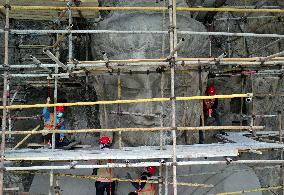
(220416) -- LUOYANG, April 16, 2022 (Xinhua) -- Aerial photo taken on April 13, 2022 shows staff members examining a Buddha statue at the Fengxian Temple of Longmen Grottoes during a restoration project in Luoyang, central China's Henan Province. A restoration project is now underway at the Fengxian Temple, the largest cave of Longmen Grottoes. Water seepage and perilous rock bases are the two factors that threaten the existence of cultural relics in the grottoes. New technologies have been adopted in the restoration, such as ground penetrating radar detection and protective nets design. This has been the first large-scale restoration project of the temple since 1970s. The restoration started in December 2021 and has so far completed about 70 percent. The whole project is expected to finish in June this year. (Xinhua/Li An)

  •  
CHINA-HENAN-LUOYANG-LONGMEN GROTTOES-RESTORATION (CN)

CHINA-HENAN-LUOYANG-LONGMEN GROTTOES-RESTORATION (CN)

(220416) -- LUOYANG, April 16, 2022 (Xinhua) -- Aerial photo taken on April 14, 2022 shows staff members examining a Buddha statue at the Fengxian Temple of Longmen Grottoes during a restoration project in Luoyang, central China's Henan Province. A restoration project is now underway at the Fengxian Temple, the largest cave of Longmen Grottoes. Water seepage and perilous rock bases are the two factors that threaten the existence of cultural relics in the grottoes. New technologies have been adopted in the restoration, such as ground penetrating radar detection and protective nets design. This has been the first large-scale restoration project of the temple since 1970s. The restoration started in December 2021 and has so far completed about 70 percent. The whole project is expected to finish in June this year. (Xinhua/Li An)

  •  
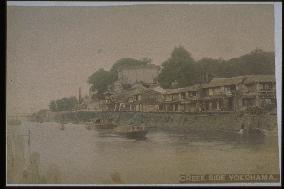
Motomachi and Tanido-bashi Bridge seen from the foreign settlement

Motomachi and Tanido-bashi Bridge seen from the foreign settlement

View of Motomachi from No. 109 Settlement. Horikawa Waterway in the foreground was dug in 1860 and served as a border between the foreign settlement and Motomachi. The expansion and embankment works were conducted according to R.H. Brunton's design in 1868. The large roof in the centre is Motomachi Zotokuin Temple.==Date:unknown, Place:Yokohama, Photo:unknown, (Credit:Nagasaki University Library/Kyodo News Images) [Cabinet Number55‐4‐0]

  •  
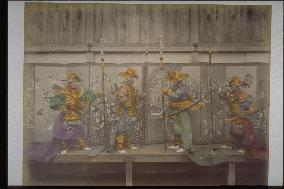
Screen with a picture of dance at rin-ouji temple

Screen with a picture of dance at rin-ouji temple

Four men in armor are standing in front of the golden screen at Rinoji Temple. The bugaku costumes were dedicated to the temple together with the screen on the occasion of the 21st anniversary of the death of the Shogun Tokugawa Ieyasu. The four wear the same armor, and the design of the costumes is the same but different colours are used for each. The screen in the background is not coloured.==Date:unknown, Place:Nikko, Photo:Kusakabe Kinbei, (Credit:Nagasaki University Library/Kyodo News Images) [Cabinet Number1‐17‐0]

  •  
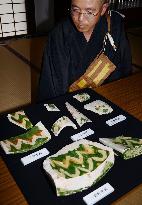
Nara Sansai-style tiles unearthed in Toshodaiji

Nara Sansai-style tiles unearthed in Toshodaiji

NARA, Japan - Fragments of Nara Sansai (tricolor) -style tiles with a unique wave design unearthed at Toshodaiji temple in Nara, western Japan, are displayed in Nara on Oct. 9, 2014. (Kyodo)

  •  
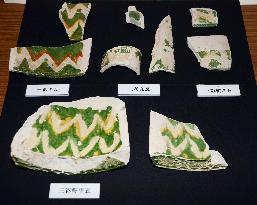
Nara Sansai-style tiles unearthed in Toshodaiji

Nara Sansai-style tiles unearthed in Toshodaiji

NARA, Japan - Fragments of Nara Sansai (tricolor) -style tiles with a unique wave design unearthed at Toshodaiji temple in Nara, western Japan, are displayed in Nara on Oct. 9, 2014. (Kyodo)

  • Main
  • Top
  • Editorial
  • Creative
  • About Us
  • About ILG
  • Terms of use
  • Company
  • BEHIND
  • Price List
  • Single Plan
  • Monthly Plan
  • Services
  • Shooting
  • Rights Clearance
  • Support
  • FAQ
  • How To Buy
  • Contact Us
  • Become a Partner

© KYODO NEWS IMAGES INC

All Rights Reserved.

  • Editorial
  • Olympics
  • News
  • Sports
  • Japan
  • Tech
  • Royal
  • Disaster
  • NorthKorea
  • Old Japan
  • SNS
  • Creative
  • Food
  • Japan
  • Landscape
  • Animal
  • Popular
  • #Ukraine
  • #China
  • #coronavirus
  • #N. Korea
  • #Thailand
  • #Russia
  • #Ukraine
  • #China
  • #coronavirus
  • #N. Korea
  • #Thailand
  • #Russia
  • Food
  • Japan
  • Landscape
  • Animal
  • Olympics
  • News
  • Sports
  • Japan
  • Tech
  • Royal
  • Disaster
  • NorthKorea
  • Old Japan
  • SNS